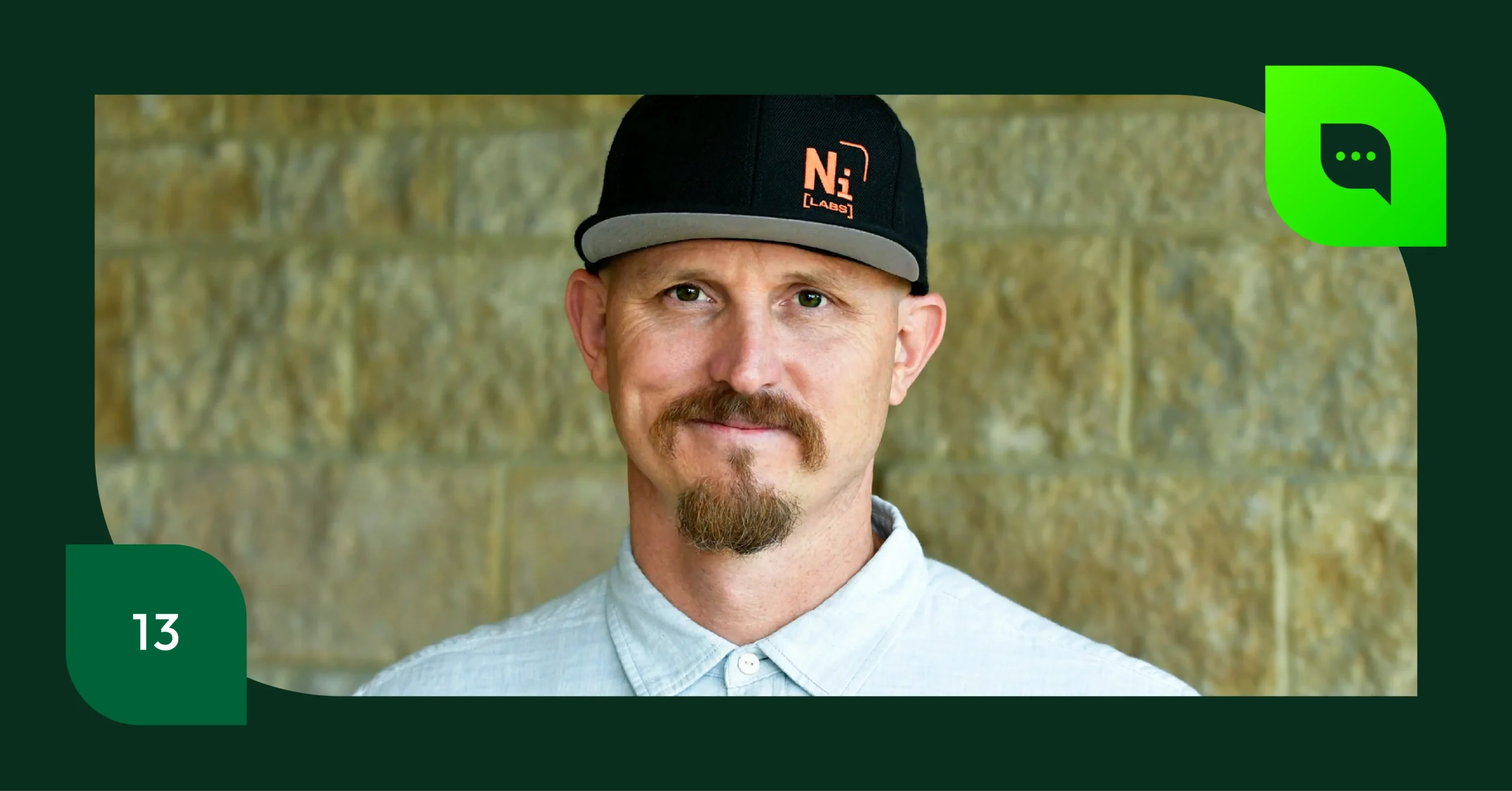
When Mick Ebeling’s team visits homeless veterans at the Los Angeles VA on Veterans Day, they encounter something unexpected. According to Mick, every person they approach with offers of help responds the same way: “I’m good. There’s someone else over here, though, that you should help.”
These are people living on the streets. Yet their first instinct is to redirect resources to others.
This paradox of finding the most generous hearts in the most difficult circumstances is what drives the work of Not Impossible Labs, the innovation studio Ebeling founded to tackle what he calls society’s “absurdities.”
What Makes Something “Absurd”?
Ebeling doesn’t use fancy terminology to describe the problems his team solves. He calls them absurdities. As Mick explains, absurdities are simply the things that make you think, “That’s ridiculous. Why does the world work that way?”
One example is a paralyzed artist living 13 miles from downtown Los Angeles who couldn’t communicate with his father and brother because he didn’t have the right insurance. Meanwhile, other patients in the same hospital with the same condition could talk freely.
“That’s absurd,” Ebeling explains. “That doesn’t make any sense. It’s not right that a father and a son can’t talk to their brother, to their son, because they didn’t make the right amount of money, they didn’t have the right amount of insurance. That’s stupid.”
Not Impossible’s response? They created the Eyewriter, “a low-cost ocular recognition device for a paralyzed artist to draw again for the first time, using only their eyes.” The device was made from cheap sunglasses, coat hangers, duct tape, and zip ties. Total cost: less than $100.
From Pundits to Doers: Taking Action on What Matters
When asked what separates those who create change from those who simply observe it, Ebeling is direct: “I believe that there [are] people who do shit and there’s people who comment on shit, or there’s pundits and there’s doers. And I feel like there’s too many people in this world who love to comment and love to talk about and be pundits, and there’s not enough people in the world who actually do things.”
This propensity for action was instilled early. Ebeling grew up in a middle-class family in Tempe, Arizona, where his parents started the state’s first clinic for abused women.
Ebeling recalls the way he and his brother were expected to care about others, even in what some might consider small ways. After family camping trips, his father would make Ebeling and his brother pick up all the trash in the campground, even though it wasn’t theirs.
“My dad’s comment was, ‘You know, if everybody left the campsite cleaner than when they found it, you wouldn’t have a campsite that had trash at all,'” Ebeling recalls. As kids, they were just annoyed. As adults, they understood the lesson: leave every place better than you found it.
The Selfish Case for Helping Others
Ebeling’s philosophy on helping others is a little different than some. He argues that doing good for others is actually the most selfish thing you can do, because it makes you feel better.
“There’s a chemical that releases in our body that when that happens, when we do something kind for another person, it is actually stimulating us. It actually gives us this euphoric feeling that actually helps our health and it helps who we are as people,” he explains.
This reframing matters because it removes the burden of acting out of pure altruism and acknowledges what most of us know from experience: helping others helps ourselves. The times when we’re most self-focused are often when we feel worst. The times when we’re focused outward tend to be when we feel most alive.
Hunger Not Impossible: Solving Food Insecurity Through Frictionless Innovation
One of Not Impossible’s current initiatives tackles a staggering problem: 50 million Americans lack food security. These aren’t all people who are homeless or unemployed. They’re often working multiple jobs, living multiple families in a household, grinding to make ends meet, and still can’t reliably feed themselves or their children.
“That’s absurd,” Ebeling says. “That’s ridiculous. It’s… inciting a little bit of disgust and anger in you when you make that realization and you say, ‘I’m not going to sit by and just let that happen.'”
The solution? A program called Bento (evolved from Hunger Not Impossible) that leverages the existing digital infrastructure of food delivery. Every food product already has a digital signature through DoorDash, Grubhub, Uber Eats, or grocery chains. Bento brings these signatures together and allows food-insecure individuals to select groceries curated for their needs, whether kosher, gluten-free, lactose-intolerant, pescatarian, etc.
The financial transaction happens on the backend, sponsored by healthcare systems or charities that have a vested interest in keeping people healthy. The groceries are picked and delivered by regular workers who have no idea they’re serving food-insecure families. It’s just another order.
Last quarter, Bento averaged 40,000 grocery orders per month. Health markers improved right alongside the local economies because the food came from local grocery stores.
This is what Not Impossible calls “frictionless innovation” which means creating solutions that don’t ask systems to change their behavior but work within existing structures.
Help One, Help Many
For small business owners or individuals wondering where to start, Ebeling’s advice is simple: don’t start by trying to serve 40,000 people.
“We started by working with a couple kids in the local Venice area, with a group called Safe Place for Youth, and we had a theory of what might work, and we tested it and it worked. And then it just kind of grew and grew and grew from there,” he explains. “If you start by helping one person and solving a problem, that absurdity for that one person, and then telling the story of that one person, that can lead you to being able to do it at scale.”
The key is focusing on what you’re passionate about because when things get tough, and they will, passion is what keeps you going.
Technology and Story: A Powerful Combination
Not Impossible’s mission statement is “change the world through technology and story.” The innovations matter, but Ebeling believes the stories are even more impactful.
“If a tree falls in the woods and no one’s there to hear it, does it make a sound? The answer is no,” he says. “You have to hear it.”
This is where Not Impossible’s background in video production becomes crucial. They don’t just solve problems but they document the solutions in ways that move people to action.
What Impact Really Means
When asked what the word “impact” means to him, Ebeling offers a perspective that ties together everything Not Impossible does:
“Impact conventionally has to do with what you do to others. It impacts others, which I think is great, that people think about the impact that this is going to have on an industry, on a society, on a disease, on whatever it might be. There’s an impact that happens to something. I think that what I’ve learned over the course of Not Impossible is that the things that we deploy and the things that we have created, the things that we have released, have impact on other people. But the impact that it has on us is the same, if not greater.”
The impact isn’t one-directional. It’s a flywheel. You do things you love in a way that contributes to others, and in doing so, you contribute to yourself.
Your Turn
Not Impossible Labs has created eye-tracking devices for paralyzed artists, 3D-printed prosthetics in refugee camps, and food delivery systems for millions of food-insecure Americans. But every project started with identifying one absurdity and taking one small step to address it.
What absurdity do you see in the world that makes you think, “That’s ridiculous. That shouldn’t be that way”?
What’s one small step you could take to change it?
As Ebeling’s father taught him: if everyone left the campsite a little cleaner than they found it, we’d all be camping in a much better place.
Learn more about Not Impossible Labs and follow their work @notimpossiblelabs on social media.
Love stories of impact? Let’s bring yours to life.
We’re passionate about helping mission-driven organizations share stories that inspire action. If you’re here for the Impact Lab Podcast, you already know the power of storytelling—now see how we can help you tell yours.
Explore our portfolio to see how we craft compelling videos, animation, design, and social content that make a difference.