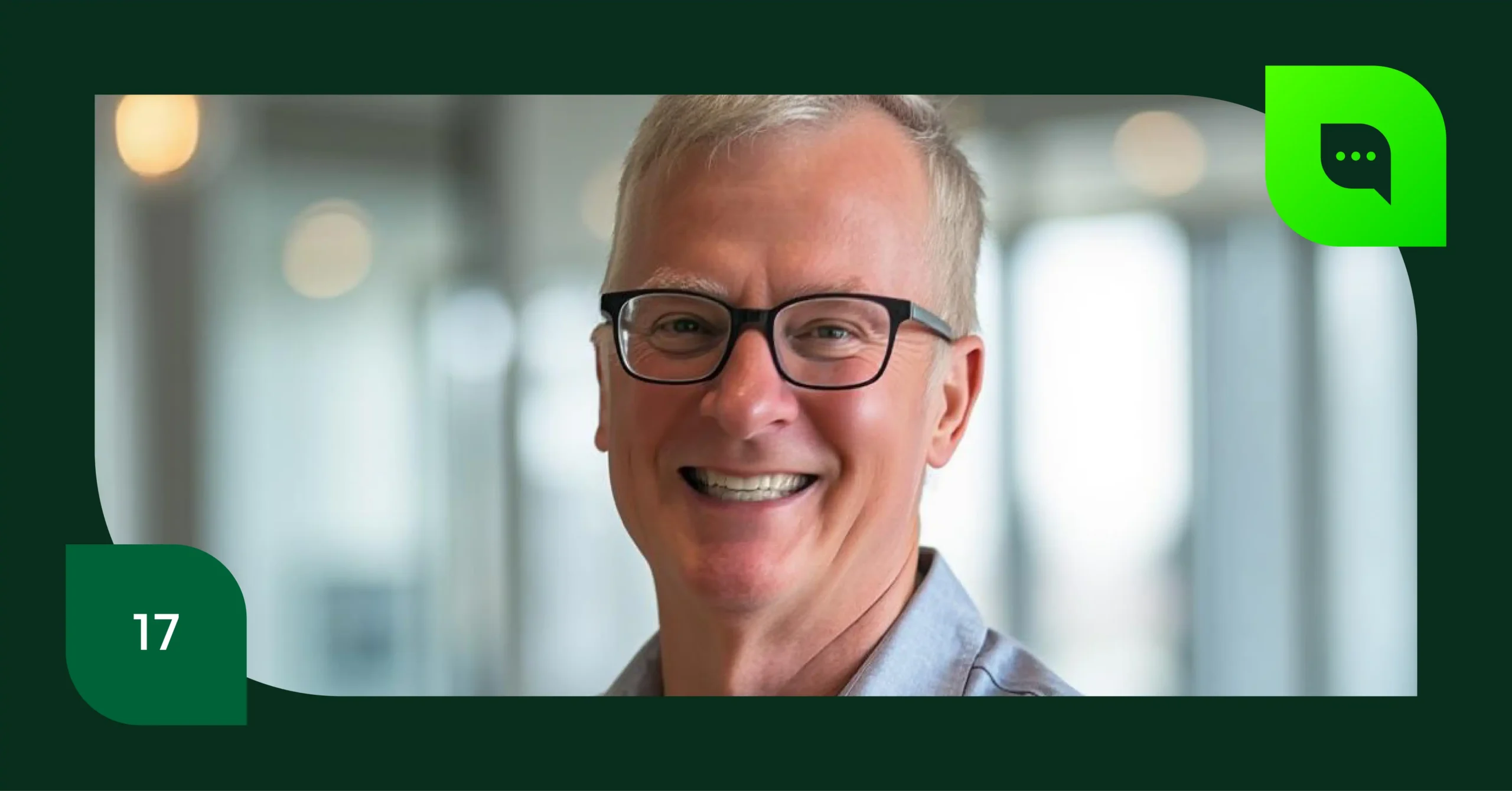
Tom Hering cares about making values-based business practices possible for all. While certification bodies often seem daunting or inaccessible to small businesses, Benefit Corporations for Good (BCFG), an organization Tom co-founded along with Mary Anne Harmer, “exists to help small businesses use their values as a competitive advantage while offering a credible and accessible alternative to traditional B Corp certification,” according to their website.
Tom sat down to speak with Elin Barton of “The Riveo Impact Lab” to discuss his journey to his current career, the power of storytelling, and how small businesses are often positioned to make the biggest difference in their communities.
A Career In Three Acts
“So, you know my career has really had three distinct acts,” Tom says. “And they’re all connected by this thread of storytelling and persuasion, each point kind of pushing me a little deeper than the last.” Tom’s first two acts were in marketing and advertising- in which he first worked for small agencies in Portland and Seattle and then for his own company.
Tom knew that his main concerns were not financial, but were about finding meaning in the work, and doing good for others. This awareness led him to the connections which were vital for the third act of his career.
“This third act kind of got bubbling up. And I really wanted to do something meaningful, really heart centered.” Of this shift, Tom says, “The turning point, it really wasn’t that dramatic as much as it was, it’s time to take these skills that I’ve acquired to this point in life and do something with them that has impact.”
When Tom realized he was ready for this next act, his first step was to work together with Mary Anne Harmer to offer senior level leadership and marketing expertise to non-profit organizations. In 2018, though, they were introduced to the concept of the Oregon Benefit Company and made the switch to being a benefit corporation certification organization. “We felt that was a better mesh of our business skills and our desire to do good. This was kind of the perfect intersection.”
An Introduction to Benefit Corporations
Benefit corporations, in some states referred to as “benefit companies,” are companies that have prioritized sustainability within their business model via legal means. Tom explains that for a benefit corporation, “You have baked in a responsibility because it is part of your articles of incorporation on the state you’re registered in, to make your decisions based on people and planet, in addition to profit. ….it’s the stakeholders model really at its basic roots.”
Tom goes on to explain that a company or organization can become a benefit corporation through their state when incorporating, by checking a box, and then adopting a third party standard, such as B Corp, Green America, BCFG or GRI (Global Reporting Initiative). (At the time of writing, 40 of the 50 states have this legislation in place.)
Based on the third party standard you adopt, guidelines are followed which include publishing an “an annual benefit report, that states how you improved, made material positive impact on society, on the people, on the planet…And then that has to be distributed somehow and normally it’s on your website,” says Tom.
Some third party standards, BCFG included, require that the annual benefit report is shown on a company’s website, and companies are assessed yearly.
First Time Hearing About This? You’re Not Alone
Tom was made aware of benefit corporations when a friend who worked at the Oregon Secretary of State’s office held an informational session.
“One of the biggest problems that continues, anybody in this movement knows this, is that the benefit corporation in whole is not very well known, even though in Oregon it’s been [around] since 2014 and some states, I think Maryland was the first state, it was 2008.”
Knowing this problem has given Tom a chance to utilize his strong marketing background to find ways to spread the information, so that more companies are made aware that this is an option for them.
“Part of what Mary Anne and I did initially, and what’s still part of what drives me, is that I need to just get out and share this, be an evangelist, share this idea that if making social environmental impact is important to you, if you want some accountability, then this is a great way to go in terms of building your business and attracting talent and attracting customers and being a great community member, standing well in the eyes of your community.”
Small Business and Benefit Corporations
For Tom and BCFG, the focus is on the small business community. While they work with a few larger corporations, Tom says the majority are small businesses and so he has witnessed firsthand how small businesses are better suited to big pivots.
“Not only do we believe that [small businesses] can make as much a difference as a large corporation, they’re usually geared to move quicker in that direction. You don’t have a board to go through. You don’t have a law review that you have to do. If you, as a small business owner, make a decision that gets done relatively quickly…you might consult with your attorney or you might consult with your CPA on that, and sometimes we suggest that, but it’s the nimbleness of a small business to be able to make that change and to go quickly at it.”
The value that small businesses can bring is not always matched by ease of access when it comes to certification processes. Tom and BCFG are looking to change that.
“We felt that other certifications were just too time consuming and too costly. So while ours is not going to be as rigorous…it’s still, as we call it, kind of the on ramp to B Corp certification, if that’s your goal as a business leader…I’m getting some spillover from some other businesses that have been B Corp certified. But they liked our standard and felt it fit them better,” he says.
Getting the Word Out
At the time of writing, BCFG represents businesses from 13, “soon to be 14” states and will represent a Canadian province, but Tom has even bigger goals. “It’s a wonderful thing, people finding out about it. And I’m looking to build our community so that this becomes as well known as B Lab’s certification.”
To make this vision a reality, Tom has sought the advice of trusted business leaders who are dual certification businesses – certified by both B Lab and BCFG. In June of 2025, Tom consulted these leaders and “gave them my short vision for the next three years. I said, I really want to build benefit corporations for good. I need your help.”
These business leaders gave Tom a piece of key advice.
“One of the big things they told me to get this story out further… is through speaking. So I’ve worked really diligently where I’m out meeting with people, or I’m speaking to groups as frequently as I possibly can. And my whole mission on these…is to inform, not sell.”
Tom says people are persuaded through the data he is able to present to them from places like Deloitte and Edelman. The research he cites centers on topics like hiring and attracting a younger customer base.
Tom has found that what the younger generation wants to know of a company or organization are the answers to the questions, “What do you stand for? What do you stand up for?”
In addition to speaking as often as possible and having direct communication, Tom relies on a student team from his alma mater, the University of Oregon, to build social media campaigns.
Tom has also begun creating YouTube shorts where he answers questions like “What is a benefit corporation,” “Why should I do it?” “What are the requirements?” and “Will this help me be a better purpose driven leader.”
Finally, the BCFG website offers companies a chance to assess where they’re at and what their next steps might be in considering certification. Individuals are able to take a 12 question values-alignement quiz that lets them know whether they are ready to begin the certification process or if there’s more work to do first. Through the BCFG website, people can also reach out to Tom directly to have a conversation.
In all of these ways – speaking, social media campaigns, YouTube, and making the BCFG team accessible- Tom is doing his part to get the word out.
Is “Doing Good” Really Good for Business?
Valuing people and the planet as well as profit not only benefits the world around a business, but the business itself. Tom talks about two main ways this plays out in the research.
“What’s good for your business is that you want to get the right employees, the right team members, to help you carry out the mission of your business. And this is one way that you know you have the ability to do that. You can talk about your ethos as a business…When I’ve seen business surveys for small business, attracting good talent is hard. It’s a big pain point. It’s probably the number one challenge.”
Tom notes that Gen Z in particular wants to know that the company they are working for is not primarily concerned with money, and that they have to see a “purpose beyond profit.”
Secondly, leading with values helps a business retain talent and keep their current employees motivated.
“There was a company that really just studied the millennial generation. It put out reports, deeply research-driven reports, on what that generation was thinking about for jobs, for the future, for what kind of things they were buying. And it was overwhelmingly in favor of a company that is doing good. And not just having a PR department spinning things out, but having some accountability baked into that business.”
Committing to a benefit corporation status allows a company to prove that their values really do matter to them, helping both retain and attract like-minded talent.
The First Step
Tom remains clear that small businesses are the change agents we need in our communities.
“The one thing that I always tell leaders that come to me is that…small business owners are powerful change agents for our economy. They hire locally, they usually buy locally. There are so many good things that keep that particular economy of that community humming thanks to their efforts.”
For small companies who are stretched thin, certification might feel overwhelming, but Tom recommends taking their alignment quiz as a first step. “It’s free. You won’t get anybody following up trying to sell you anything. See where you are.”
The next step is simple. “Regardless of whatever comes back then talk to your team. Share this information. See if they are aligned with your thinking as a leader, that this is something that I want to do.”
The Cost and Logistics of Certification
To get certified, companies will receive a link to a 60 question assessment. They can, but are not required to, provide supporting documentation for their answers, and they are assessed on eight areas. “They’re based on our eight standards of understanding the purpose of benefit corporations- what we call Conscientious Leadership, DEI, Green Practices, Community Engagement, Customer Service, Strategic Business Practice and work life, but we call it Life Balance.”
The assessment is purposefully straightforward and robust without being too rigorous so as to remain an attainable goal for small businesses. Once the assessment is completed, the company will receive an evaluation within a few weeks in which they will learn what they did well and where to improve. If the company becomes certified, they are then provided marketing advice on how to “leverage certification to your community,” Tom says. BCFG also provides a free resources page on how to write a benefit report.
Unlike other certification bodies that charge based on company revenue, BCFG charges based on full-time employees, with their lowest price point starting at $299 for 5 FTEs or less, with recertification at $199/year. Tom wants to keep the price low so that more companies are able to afford certification.
“My board says you need to raise your fees. You need to pay yourself. I said, ‘That’s not the point right now for me. I just want to help these small businesses get going. I’ll pay out somewhere along the line.’”
Hope for the Future
For Tom, his hope for the future comes from the trajectory of the young people he interacts with. Following a talk he gave at Portland State University, Tom was encouraged by the engagement of the students, the questions they asked, and their interest in making a positive difference for the future.
“Young people in particular are looking for change. And again, there’s a ton of research just on politics right now about what young people believe and think. …I think this is going to be one of those things where becoming certified as a B Corp or a Benefit Corporation or through Green America or whatever the certification is, I think that’s going to be as standard as getting a business license…it’s going to be mainstream. And I think this next generation or two are really driving that change…this is where I get a ton of hope.”
Conclusion: Real Impact
As a child, Tom learned to “leave the campsite better than you found it,” in his time as a Boy Scout. It’s this principle that drives him today and that he has imparted on his own sons.
“I think on a personal level, this third act has been without a doubt the most meaningful part of my career… I get people that not only want to make an impact, but are practicing that in their business, [and] in their personal lives. And that’s what I’m trying to do, one certified BCFG at a time.”
Learn more about Benefit Corporations for Good or connect with them on LinkedIn, Instagram and Facebook.
Love stories of impact? Let’s bring yours to life.
We’re passionate about helping mission-driven organizations share stories that inspire action. If you’re here for the Impact Lab Podcast, you already know the power of storytelling—now see how we can help you tell yours.
Explore our portfolio to see how we craft compelling videos, animation, design, and social content that make a difference.