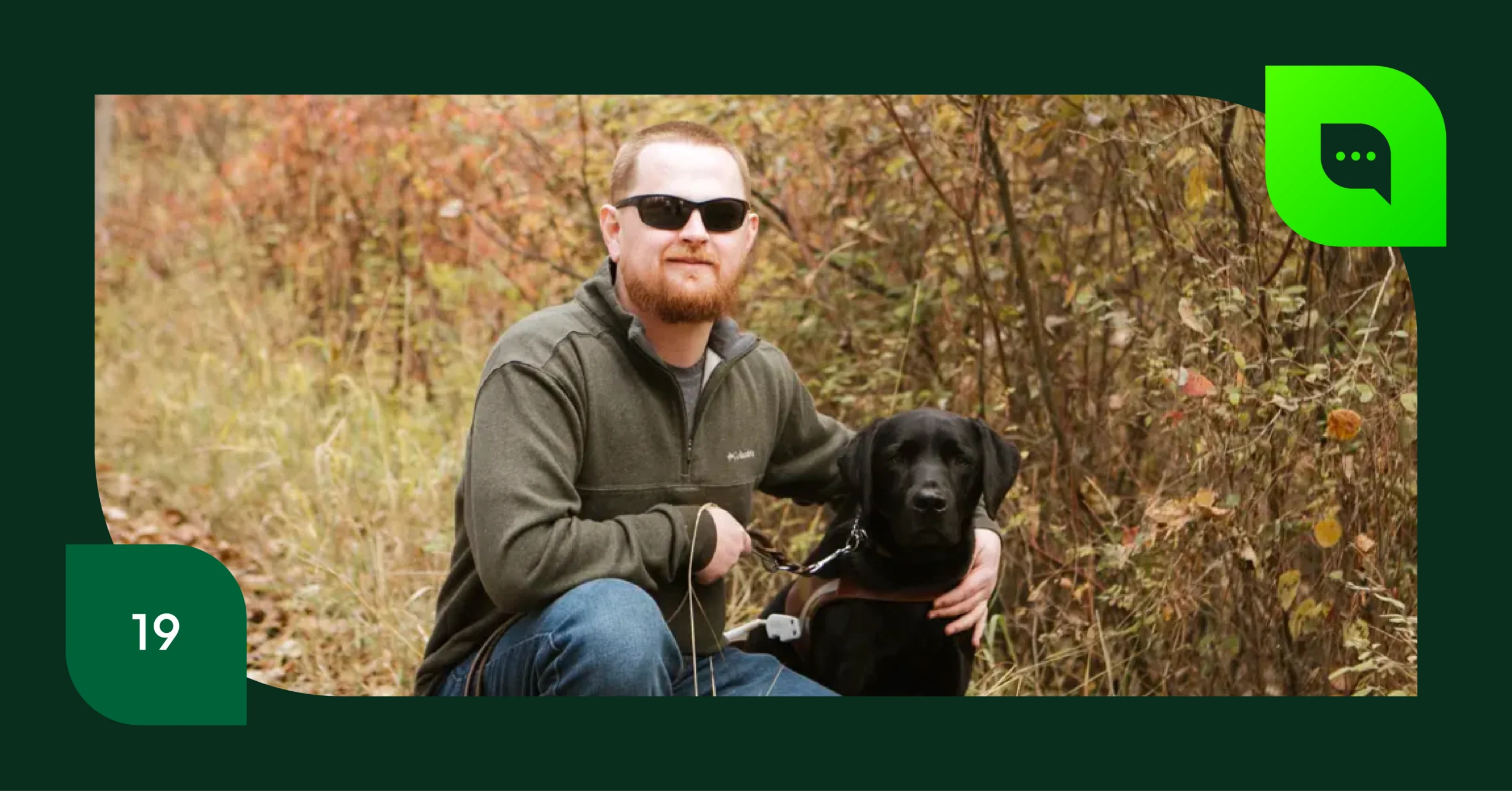
Aaron Page believes in digital equity.
“Digital equity means equal access to information,” he says. “Whether it’s a website, it’s a mobile app, it’s an electronic document, digital equity means that those digital environments, those digital platforms, they are just accessible. They just work.”
As a longtime professional in the digital accessibility space, and a person with lived experience as a blind technologist, Aaron is on the forefront of making information easily and equitably accessible to users with disabilities.
In this article, you’ll learn about Aaron’s background, what the landscape of digital accessibility looks like right now, and how you and your organization can take steps to ensure you’re doing your part to move us all closer to an equitable world.
The Intersection of Accessibility and Technology
Aaron currently serves as the VP of Accessibility at Allyant, a company that, according to their website, offers a “comprehensive suite of accessibility solutions ensuring equitable access to digital, document and printed information for people with disabilities.”
Aaron’s journey towards a career in the accessibility space, is one that still surprises him when he looks back. “[It was] just an amazing coincidence of time in a sense… kind of blows my mind sometimes when I think about it that way.”
Aaron was born with congenital glaucoma, and after losing his remaining vision at 22-years-old, he made the decision to return to school. Aaron first attended a training program for the study of braille, assistive technology, independent living, and mobility skills, before enrolling in the University of Montana where he received his Bachelor’s Degree in Business Administration.
It was while studying and working at the IT Help Desk at the University of Montana, that another student filed an Office of Civil Rights Complaint, saying that as a blind student, they found the university’s electronic and information technology inaccessible. This situation was an initial stepping stone to Aaron’s professional life today. He explains,
“The university ultimately had to do a settlement agreement with the Department of Education, and as part of that settlement agreement, they had to put together an accessibility program from scratch, including things like testing software, doing training, you name it. And so they realized when starting to put together their program, they had this blind student who was working in the IT help desk and actually asked me if I would be interested in working with them to do software testing, accessibility trainings, workshops… And so I agreed to that and started doing accessibility work as a student employee.”
Aaron continued this work after graduating, becoming employed as a staff member at the university for several years, before taking a job as a screen reader auditor at Accessible360, a company that eventually became Allyant, where Aaron holds his position today.
Aaron doesn’t take his career for granted. “What a rare opportunity that I get to work for a business – a for profit company and the kind of benefits that come along with that – while doing good work promoting equal access to information…I’m very thankful for it.”
The Creation of Allyant
While the name “Allyant,” only arrived on the scene in 2022, the company has been doing the work of accessibility since the early 1990s. According to Aaron, Allyant is a “combination of three legacy accessibility companies: T-Base Communications, Common Look, and Accessibile360.” Aaron explains that each of these companies performed a different function within the accessibility space: T-Base Communications dealt with alternative formatting, CommonLook with PDF and electronic document accessibility, and Accessible360 with web and mobile accessibility litigation support.
“So by combining these three organizations together into what is now Allyant,” says Aaron, “we really created, we like to say, the world’s only trusted, end-to-end accessible communications provider.”
Aaron says that this ability to handle all these aspects of accessibility support makes Allyant unique.
“If you are a city water department,” he explains, “and you have a website that you need to make accessible, an online payment portal that needs to be accessible, you have billing statement PDFs that need to be accessible, and you need to be able to provide braille upon request or large print, Allyant is equipped to be able to do all of that within one organization rather than farming it out to three.”
Digital Equity Over Accomodation
Throughout his work, Aaron uses the term “digital equity,” to express what it is he wants to see in the world. Aaron defines the term as “equal access to information,” that doesn’t require accommodations. He explains:
We here in the United States often have a very kind of accommodation-centric mindset. If somebody needs access to something and it’s not accessible, we’ll provide reasonable accommodation at that time. It’s kind of thought of as the baseline, but that’s not really digital equity. Because that involves now that disabled user has to self-identify, they have to submit a request…So an accommodation doesn’t mean something is equitable or accessible. It’s what you do when something’s not.
Digital equity means that if something is truly accessible, it just simply works. I, as a screen reader user, can visit the website and it just works. I don’t have to turn on accessibility mode or flip some switches, or use the separate view of the website. If a PDF document is accessible, a student who downloads it can just simply open it and it will read with their screen reader. They don’t have to send it to services and wait two weeks for the alternative format to be created and sent back to them.
It’s much like architectural accessibility. We think of things like ramps, right? And if you build a building with accessibility in mind, people who rely on wheelchairs and things like that are able to just simply get in. The building is designed with those things in mind. They don’t have to ask for help to do it. That’s the goal that you want to achieve for your digital environments as well.
Accessibility Wins
When considering the landscape of accessibility today, and whether or not we’re getting closer to achieving digital equity, Aaron notes some positives on the legal end, as more regulations are put into place. While he’s clear there are some laws and regulations he likes and some he doesn’t, overall the “win” is the “change in mindset.”
In fact, in Aaron’s experience, while there are still organizations that come to Allyant for litigation support, “The majority of our customers now are coming to us proactively because of laws and regulations, rather than reactively because of litigation. And I think that is just a huge win.”
If you’d like to look further into some of the laws and regulations Aaron mentions, check out The Accessible Canada Act, the European Accessibility Act, the United State’s Title II regulations, and HHS regulations.
Room to Grow
While there are plenty of reasons to feel encouraged when it comes to moving toward digital equity, for Aaron, there is one clear area with significant room for improvement: third party integrations. Aaron explains that the issue with third-party content is that if an organization neglects doing their due diligence to ensure that service is accessible, then they will often be held responsible if it isn’t. Aaron offers this example:
“One thing that has been very surprising to me over the years working in accessibility is how websites, mobile apps – these digital services- they just naturally grow and expand over time, and eventually they can reach a point where the organization doesn’t really know what they have anymore. It’s running on autopilot. They don’t know where all of their electronic documents are stored because they’re scattered throughout the entire website. They don’t know specifically what third party solutions they have integrated because maybe some of them are free… So conducting that inventory just to know what you have – where are all of your documents? What are the accessibility issues that can be found by a scanner? What are those third party tools that you have? Inventorying those things can really kind of help you know where to move…Where do I have the largest accountability debt that I can start working on?”
Accessibility As a Foundational Principle
For some organizations, accessibility is an afterthought or something they have to be convinced to do, while for others it is a foundational principle or one they are excited to incorporate. When considering the difference between these two types of organizations, Aaron says the benefit of being proactive with accessibility is that an organization is able to seamlessly incorporate it into their processes, rather than having to scramble to meet a last minute deadline or fix an issue that’s come up through a lawsuit. When this happens, Aaron says,
“You don’t have that flexibility to really weave [accessibility] into your existing processes. It really becomes this more ‘All hands on deck, the sky is falling now, we have to do everything we can now. We can’t actually work on our software roadmap for the next six months because we waited on accessibility and now we have to throw everything at that.’ And so the control that you have and that you lose over your own development life cycle and workflows to me is probably the biggest difference [for] an organization that takes accessibility proactively.”
Teaching Others the Importance of Accessibility
When asked whether it’s worth it to try to explain the value of accessibility to others if they don’t inherently understand, Aaron believes it’s important to start with the assumption that people are not intentionally creating inaccessible digital spaces. For him, education is the starting point. “I always want to educate. If it becomes evident that education isn’t working or isn’t being received, there’s only so much you can do. And at that point, you’re better off focusing your attention and resources on those who really want to embrace accessibility and work on it.”
For those that don’t embrace it, though, there are potential consequences. Aaron recalls a story from his time as a student at the University of Montana. While presenting a document accessibility workshop alongside an instructional designer, a professor asked them, “So if I just print everything out and provide everything on paper, can I avoid doing all of this?” indicating he would rather stop using digital services altogether than make them accessible. Aaron still sees that mindset reveal itself when people are presented with accessibility requirements today:
“When I was reading the Interim Final Rule for the DOJ Title II regulations…some of the comments that were provided kind of said the same thing. ‘Oh, well, these regulations are so onerous that we’re just not going to have digital services. We’re not going to allow people to pay their bills online. We’re not going to host meeting minutes online.’ And, you know, my kind of snarky response to that is, ‘Good luck.’
To a professor who wants to just provide everything on paper, your students are going to riot. To a community who wants to do everything on paper and not provide its citizenry the ability to do things digitally, your citizens are not going to appreciate that. And they’re going to vote for people who provide those services for their community.”
A Success Story
Aaron remembers a particular success story from his time at Allyant that still makes him smile. He mentions that there is a cottage industry that’s formed around serial accessibility litigation, and in this case litigants targeted a small-medium-sized business that had been doing the work around accessibility.
“This customer of ours, they really had gone above and beyond. When we audit a website, we provide criticality ratings – critical, serious warnings. They fixed everything, all priority levels, every issue in their project that we had found was fixed 100%. That’s not a common thing for us to see. And so these guys really did everything that they could. And they still got targeted by the serial litigation.”
Luckily, not only had Allyant provided them with the tools to become more accessible, they were also able to provide this client litigation support. Because Allyant had screen-reader users employed on their team, they were able to resource their client with a rebuttal report and a demo of a blind screen-reader user navigating the very website the lawsuit had claimed was inaccessible.
After proving the website was in fact accessible, and worked well for screen-reader users, the client was able to settle – for zero dollars.
“That just tickled me pink,” Aaron says, “because, not only did we make a website accessible – I fully stand by the fact that blind people can use that website, it is accessible – we also helped them swat down this serial litigation. Just such a win-win all the way around.”
The Power of the Demo
For Aaron, there is real power in having people with lived experience providing accessibility education and assistance.
“One of the things that I learned very early on doing the workshops and training at the university was the power of the demo. Instead of just saying, ‘Professor, your course syllabus is inaccessible,’ I would have a TV on a cart rolled in and connect my laptop to it, and I would pull up their syllabus on it and read it with the screen reader. And it wasn’t meant to name and shame. What it was meant to do was to show, ‘Here’s what it actually means. The fact that you don’t have good headings, here’s what that means in reality. Like how you can scroll down quickly, I can’t. How you can jump to the sections? I can’t do that. Here’s why. Your Frankenstein’s table of merged cells and columns doesn’t make sense when you read it out with a screen reader.’ Demoing that and showing how it actually impacts those users, it always creates that light bulb moment and generally makes people more receptive to what you’re going to say after that, because now they kind of understand the why.”
Not only do people with lived experience offer an opportunity to explain “the why,” they also have practical expertise that cannot be replicated by someone without that experience. At Allyant, there is a team of native screen reader users employed in their digital group, who are all blind or low-vision, and have certain certifications – WAS, CPACC, CPWA – that put them in a better position to find real issues. Aaron explains, “Their role is to be able to test for those issues, those problems for screen reader users that a sighted engineer who knows how to use a screen reader might not find. No matter how hard you’re trying, you have that benefit of – you can see the screen, you know what’s going on. You’re not fully reliant on that assistive technology. You’re never going to be able to replicate that experience that the native user can.”
The Next Right Step
For those interested in making their services more accessible, Aaron recommends a few simple first steps – conduct an inventory, consider adding a “Skip-to-Main Content” link on your website, and have a good accessibility statement that includes “the steps that you are taking, the standard that you are meeting or hope to meet in the future, a mechanism for users to report issues if they run into barriers.”
Aaron says these steps can help you avoid serial litigation by telling serial plaintiffs, “‘Hey, this company has accessibility on their radar. They go to their website and they see, look, they’ve got a working skip-to-main link. They have an accessibility statement. Why go after this site when there are plenty of others who’ve not even taken those basic steps?’”
Accessibility as a Journey
From Aaron’s perspective, there is no such thing as “arriving” when it comes to accessibility. There are always next steps to be taken, and it’s okay to take them one at a time. He says, “You’re never going to be quote unquote 100% accessible. There is no such thing. Technologies evolve, standards evolve, our understanding of how persons with disabilities are impacted, that evolves, the tools evolve. Users have different technical skill levels with their assistive technology. There are so many variables that there’s just no such thing as something that is 100% accessible to everybody across all of those variables.” For Aaron, impact in this space happens when companies are willing to take the journey.
“To me impact, especially in the accessibility space, is just getting started on that road even if it’s taking those small steps that we talked about before…These are small, tangible wins for you that create significant impact over time.”
If you’d like to learn more about Allyant, visit Allyant’s website or connect with them on LinkedIn. You can also find Aaron Page via his personal LinkedIn page, where he provides accessibility updates and is currently working on developing a video game accessibility mod. You can find Aaron and the Allyant team at conferences like Disability:IN, M-Enabling and Accessing Higher Ground.
Love stories of impact? Let’s bring yours to life.
We’re passionate about helping mission-driven organizations share stories that inspire action. If you’re here for the Impact Lab Podcast, you already know the power of storytelling—now see how we can help you tell yours.
Explore our portfolio to see how we craft compelling videos, animation, design, and social content that make a difference.